Deep Listening: The Story Of Pauline Oliveros (Daniel Weintraub, director/Capone Productions 2023)
Video of avant garde musicians can help make real what sometimes seems close to magic. So it is with Daniel Weintraub’s new documentary, which captures the epic span of Pauline Oliveros’s life and work, parts of which were so wildly imaginative and esoteric that they could almost risk slipping into the realm of myth.
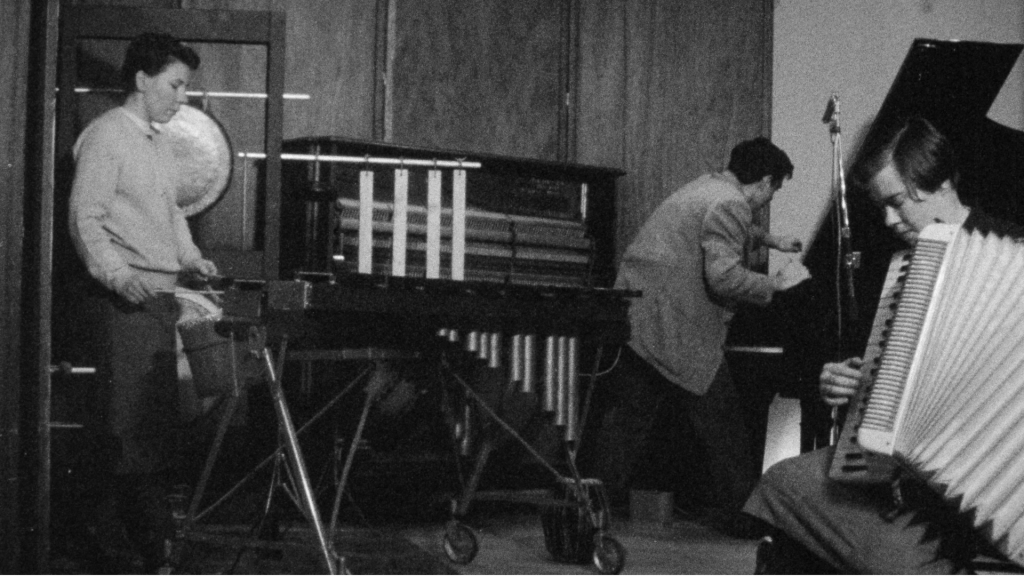
Oliveros is central to the story of 20th century experimental music, although even now, the wide scope of her work is hard to fully appreciate. She improvised, composed, curated, disrupted, and lived a singular life. She was in her mid-thirties when the first LP featuring her work emerged in the late 1960s, and had already undergone a life changing journey from conservative Texas to freewheeling California. She’d entertained partygoers on the accordion back home, but aimed from a young age to be a composer, and increasingly strived to stretch the definition of that role. In her first decade in San Francisco, she introduced improvisation as a wild card into her musical practice, experimented with magnetic audio tape and custom forms of notation as ways to organise sound, and helped build a small electronic music studio in San Francisco, making links along the way with fellow travellers Terry Riley, Ramon Sender and Stuart Dempster.
Deep Listening takes the form of a living archive which still feels full of fresh potential. A forensic trawl of flyers, photos, contact sheets, musical scores, and footage of studios and very early performances, bring an era of infinite new possibilities to life. There’s extensive interview clips with the composer, as well with as a cast of associates from across whole spectrum of the 20th century avant garde.
As the film rolls on, the footage shifts, as if in a dream, from stuffy institutional rooms to the sun-drenched California outdoors. The film shows wonderful images of happenings in the desert, ad hoc outside performances with students, and home videos of liberated parties and hang-outs. Oliveros’s most powerful attribute was the imagination, and the film’s most inspirational theme is making real what is previously hidden. Former partner and performance artist Linda Montano remembers how fluidly Oliveros could shape-shift between roles, delighting in costume and disguises, including The Big Jewish Band, where she played klezmer incognito while wearing a beard. Another vital ingredient in her work was people. Oliveros outlines a life that began to thrive in networks outside of formal institutions, especially after leaving the University of California, San Diego in 1981. “I’ve never tried to build a career. I’ve only tried to build a community”.
The final hour of the film explores her growing belief in her latter decades that listening – to music, to others, to the world – is increasingly indistinguishable from the practice of expanding consciousness, spiritual awareness, and leading an ethical life. “What have you learned about the world?” an unnamed interviewer asks her. “That it’s not listening very well,” she replies. “I’m serious.” She was prescient in prioritising the value of listening, alongside fellow trailblazers of experimental music such as John Cage, Annea Lockwood and Maryanne Amacher. The question of who might have the time, space and bandwidth to listen in the 21st century would have been a fascinating question to see Oliveros address.
Deep Listening, which was made in close collaboration with Oliveros’s estate, offers an unparalleled insight into her art and practice. Paradoxically, by documenting her work and life so forensically and with a two hour running time, it loses a little of the playfulness that was so important to her life and work. The film asserts in its introduction Oliveros’s many roles, from teacher to martial artist to genius to technological wizard, but the interviews that follow all lead back to Pauline, which dilutes some of the sense of collaboration, chance and encounter in her work.
It concludes on an optimistic note with a moving interview with Oliveros’s widow and longterm collaborator, Ione. She details a conversation with someone who experienced Pauline’s work, who walked away from it declaring “now I believe there can be peace on Earth”. That seems even further away than ever, but the film stands as testament to the reifying power of her imagination.
You can find more information about the film at paulineoliveros.us. Some excellent collections of Oliveros’s music can be found via importantrecords.com and paradigm-discs.bandcamp.com.
Photo: Laurel Johnson (left) Ramon Sender and Pauline Oliveros improvising a soundtrack, 1961 from Deep Listening: The Story Of Pauline Oliveros (courtesy Daniel Weintraub)
 Slow Motion