
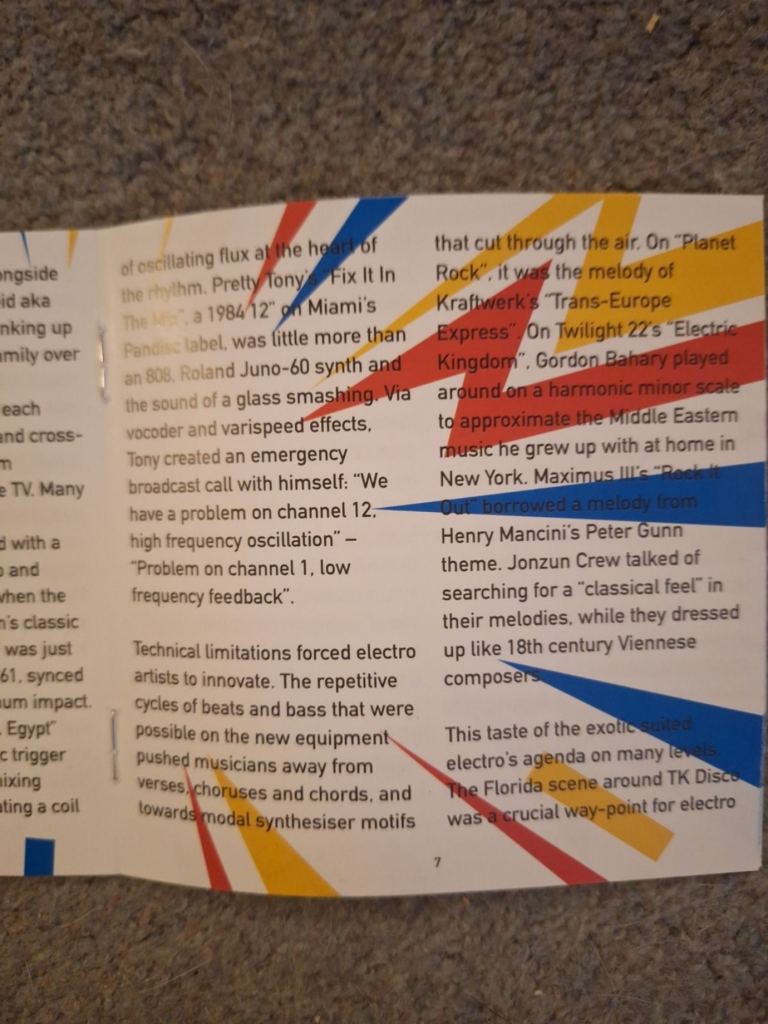
It was a thrill to get the chance to write some sleevenotes for the new Soul Jazz compilation, Electro Throwdown: Sci-Fi Inter-Planetary Electro Attack On Planet Earth 1982–89. The comp, put together by Soul Jazz’s Stuart Baker, widens the horizon beyond the brief moment of the 1982-84 electro boom to include tracks from true school survivors like Professor X/The Arabian Prince, still repping electro in 1989, as well as non-electronic bands of the era like Bill Williams’s Bileo who were being sucked into the techno-fetishism of the early 1980s with their “Robot People”. It’s out right now (side note: the CD is great value – what else can you get for 12 quid these days?).
Part of my digging for the project was working through weekly editions of Record Mirror, whose industry remit and pop savvy made it well placed to champion new fads in the chart and on the dancefloor. The publication’s longrunning columnist James Hamilton aka Dr Soul, a (literal) giant on the UK club scene who died in 1996 at the age of just 53, compiled charts of what was hot – including a Boys Town Disco chart repping the gay scene – gave up to date info on record imports from the States, noted when hits got the 12” disco mix treatment, and generally provided the word on the street from the mid-1970s until his death.
Hamilton was notable for proselytising for the importance of bpms, to DJs and for club culture more generally – Alan Jones, in a tribute after the DJ’s death, suggested that Hamilton probably bpm-ed more records than anyone on the planet.
Spending time with Hamilton’s columns from the electro era makes the music come alive again right in front of you. It’s one of those times in club music – jungle was another – when you can sense the evolution and mutation of the music on an almost real time scale, with studio innovations and dancefloor desires engaging in frantic cross talk that moulds and fires new genres and scenes.
When it comes to electro, the close-up view of the weekly music press reveals currents sometimes missed from a more lofty historical perspective. Start with the name. Hamilton riffs on electro-dance and electrophonic phunk, rather simply electro, highlighting the fusion of technology and the body. His writing has the telegrammatic quality of a quick-fire track ID, sometimes breaking down onomatopoeic exclamation: wikki-wikki!
Although electro is a rare music genre where you could venture a ground zero moment – Afrika Bambaataa & The Soulsonic Force’s 1982 single “Planet Rock” – Hamilton’s column traces the pressures and desires that formed that moment. An overlooked fellow traveller of the electro era is Marvin Gaye’s “Sexual Healing”, namechecked several times in Hamilton’s columns of late 1982 around the time “Planet Rock” was hitting. It caused a sensation with its sophisticated drum machine programming – “unbelievably, all the backing is completely electronic” – and DJs looking for similar kicks would draw for tracks like Tyrone Brunson’s “The Smurf” and Extra T’s “ET Boogie” (the latter included on Electro Throwdown). Another record just as important for Hamilton in pushing the dancefloor forward was “Don’t Make Me Wait” by Peech Boys, a project of garage pioneer Larry Levan, a record which straight out of disco but which sketches crisp edges, structures and sensations using the tech of the time.
An important chronicler of this period is the British DJ Greg Wilson, and the title of his website Electro Funk Roots stresses electro’s place in the funk continuum. Wilson was a major force as a DJ in the North West as a resident at the Golden Guinea and Wigan Pier, and gets regular namechecks from Hamilton. This contrast between regional scenes kept UK club culture moving in the early 1980s. He notes in 1983 how electro was still being embraced outside London, at a time when many in the capital were turning away from the music’s taste for bleeps and novelty FX.
What sounded new one month could easily become kitsch the next. In that context, it’s not surprising that some DJs (especially in London) sought music that preserved some of the old flavours of soul and funk. Hamilton could be scathing of the more formulaic club tracks, and singles out Jonzun Crew’s “Space Cowboy” for praise specifically because it looks beyond the latest electronic music gadgets: “a good hope for a soul future”. The intermingling of new and old, as handled by DJs like Hamilton and Wilson, was where it was at, and by the time that Herbie Hancock’s “Rockit” emerged in 1983, it is treated like the return of the future: “restores out faith in how good electrophonic phunk can be.”
An interview with Hancock in Record Mirror highlights another current into electro that’s sometimes overlooked, when the keyboardist mentions he is listening to Duran Duran and Talking Heads. The idea of novelty is crucial to electro, whether that be the new tones of electronic instruments, the sounds and cultural iconography emerging from the fast developing Japan, or the new waves of music that were emerging in the early 1980s. “Planet Rock” producer Arthur Baker was spinning the sounds of new wave and the second British invasion in nightclubs that were hungry for something different. Hamilton notes in 1983 that “the black orientated [radio station] WBLS now concentrates on playing UK recorded electro-dancers… the black acts are having to jump aboard the electro bandwagon to survive.” The group Warp 9 even tried to coin the whacky neologism nunk – new wave funk – to leverage the way tastes were changing.
Electro fantasised about spaces and places that might offer at least a slightly brighter future. At the time, Black musicians in NYC were struggling with shady business practices, white-dominated radio, and unequal access to distribution. Like the crosstalk on dancefloors between London and the rest of the UK, the dialogue between US and UK music in New York helped set the stage for electro.
The pages of Record Mirror outside of James Hamilton’s great columns give just as much of a sense of the techno-fied era taking shape. There’s vivid adverts for Sony Walkmans, Yamaha motorcycles, TDK tapes and the first handheld video games which seem to hold out as much future promise now, perhaps more, as they did at the time.
Wilson wrote a landmark essay “How British DJs began to mix” on James Hamilton, and how he shifted the role of the DJ from a microphone personality to a selector/curator behind the decks. In it, he mentions his “trips to the British Library in London to comb through the copies of Record Mirror”, which I read when I was in the British Library doing exactly the same thing. I had the uncanny feeling for a moment that we were both time-travellers back to 1982. That’s testament to the dense, inky pages of Record Mirror, which are such a potent time capsule of the technological revolution in sound.
There is an extraordinary archive of Hamilton’s columns at the James Hamilton Disco Page. You can spend hours here soaking up Hamilton’s enthusiasm and his endless stream of hot tips for the dancefloor. Why not check it out? It includes Hamilton’s game-changing column on the importance of bpms from 1979. There’s a useful reference for the site at Laurent Fitoni’s Musical Archives & Historical Resources website, which attempts to spread knowledge about this and other resources, and is well worth knowing about.
If you want to hear the Electro Throwdown comp, and read about how “electro used innovation and novelty to warp the fabric of spacetime”, you might want to swing by Sounds Of The Universe.
 Slow Motion